Skip to content
Toggle main navigation
WHO Food Systems Community of Practice  logo
  • About
  • Groups
  • Resources
  • World Food Safety Day
MoreOpen dropdown to see remaining menu items
    Log in
    Request to join
    Contact
    World Health Organization

    Av. Appia 20

    1202 Genève

    Switzerland

    [email protected]
    Links
    Nutrition and Food Safety
    Multisectoral Actions in Food Systems
    Cookies
    Withdraw cookie consent
    Community engagement platform by Hivebrite.

    WHO Publications

    All
    advocacy materials
    AMR
    chemical contaminants
    EURO
    fiscal policies
    foodborne disease estimate
    foodborne diseases
    food fortification
    food safety strategy
    food systems
    laboratory capacity
    nutrition labelling
    policy guidance
    policy monitoring and enforcement
    product reformulation
    See all

    Highlighted News

    Results (43)

    Newest
    WHO reference protocol for measuring fatty acids in foods

    WHO reference protocol for measuring fatty acids in foods

    Assessing and monitoring TFA content in the food supply is one of the key action areas for countries in order to eliminate TFA. WHO first developed and published a reference laboratory protocol for measuring TFA in foods in December 2020 (WHO global protocol for measuring fatty acid profiles of foods, with emphasis on monitoring trans-fatty acids originating from partially hydrogenated oils). Sinc
    March 16, 2026
    World Food Safety Day 2026: From burden to solutions – safe food everywhere

    World Food Safety Day 2026: From burden to solutions – safe food everywhere

    This communication toolkit was developed by WHO and FAO to present information about World Food Safety Day 2026 and this year’s theme, and to share ideas on how to take part in the celebrations on (or around) 7 June 2026.
    March 10, 2026
    Strengthening surveillance of and response to foodborne diseases

    Strengthening surveillance of and response to foodborne diseases

    This publication updates the document published in 2017 entitled “Strengthening surveillance of and response to foodborne diseases: introductory module”.The approach used by the World Health Organization to support countries in developing surveillance and response systems for foodborne diseases is introduced, along with the foundation for the full set of manuals. Guidance is provided on how to bui
    March 3, 2026
    Policies and interventions to create healthy school food environments: WHO guideline

    Policies and interventions to create healthy school food environments: WHO guideline

    Children spend a large share of their day in school, making it a critical setting for shaping lifelong dietary habits and reducing health and nutrition inequities. Yet the foods available, served, sold or promoted in and around many schools often include products high in saturated fats, trans-fatty acids, free sugars and salt, and are not aligned with national dietary guidance.This WHO guideline p
    January 28, 2026
    WHO guideline on fortification of edible oils and fats with vitamins A and D for public health

    WHO guideline on fortification of edible oils and fats with vitamins A and D for public health

    Vitamin A deficiency remains a leading cause of preventable blindness in children and also increases the risks of severe illness or death from infections. Vitamin D deficiency has become a public health concern, particularly in regions with insufficient sunshine or with sun avoidance behaviours that prevent dermal synthesis, and have infrequent access to or intake of dietary sources of vitamin D.
    November 18, 2025
    Get started toolkit - World Food Safety Day 2025: science in action

    Get started toolkit - World Food Safety Day 2025: science in action

    OverviewThis World Food Safety Day, we are celebrating the important role that science plays in making informed decisions about food. This toolkit covers what governments, food businesses, consumers, academics and schools can do to participate in World Food Safety Day, 2025. Opportunities to get involved include sports activities, food safety quizzes, exhibitions and webinars! Without science, it
    March 7, 2025
    Use of lower-sodium salt substitutes: WHO guideline 

    Use of lower-sodium salt substitutes: WHO guideline 

    This guideline provides evidence-informed guidance on the use of lower-sodium salt substitutes (LSSS).The recommendation in this guideline can be used by policy-makers, programme managers, health professionals and other stakeholders in their efforts to promote reduction of sodium intake and reduce the risk of hypertension and related noncommunicable diseases through a range of public health policy
    January 27, 2025
    The state of food security and nutrition in the world 2024

    The state of food security and nutrition in the world 2024

    This report is the annual global monitoring report for Sustainable Development Goal (SDG) 2 targets 2.1 and 2.2 – to end hunger, food insecurity and malnutrition in all its forms. It presents the latest updated numbers on hunger, food insecurity and malnutrition, as well as new estimates on the affordability of a healthy diet. Previous editions  have highlighted several major drivers of food insec
    October 16, 2024
    Reformulation of food and beverage products for healthier diets: policy brief

    Reformulation of food and beverage products for healthier diets: policy brief

    Food reformulation is the process of altering the processing or composition of a food or beverage product, to improve its nutritional profile or to reduce its content of ingredients or nutrients of concern. Food reformulation can contribute to ensuring access to safe and nutritious food for all, and shifting towards healthier and sustainable consumption patterns.This policy brief provides policy-ma
    September 23, 2024
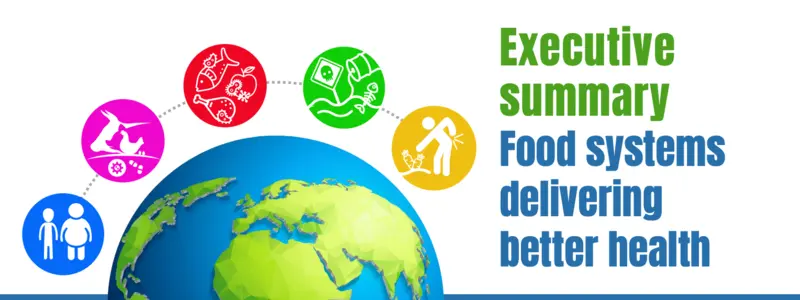
    Food systems delivering better health: executive summary

    Food systems delivering better health: executive summary

    Today, our food systems are making us ill, driving climatic change and undermining the health of ecosystems. This new “Food Systems Delivering Better Health” narrative recognizes that food lies at the heart of human, ecosystem and animal health. We must change the way we think about, produce, distribute, consume, dispose of and value food, for better health outcomes. The narrative focuses on five
    September 11, 2024
    WHO global sodium benchmarks for different food categories

    WHO global sodium benchmarks for different food categories

    The World Health Organization (WHO) has established the second edition of the global benchmarks for sodium levels in 70 food subcategories as part of WHO’s efforts in reducing the sodium intakes in populations. This is an updated edition of the first edition which was released in May 2021. The setting of global sodium benchmarks is a very important step to facilitate reformulation of food products
    September 11, 2024
    Food systems for health: information brief

    Food systems for health: information brief

    WHO is promoting the implementation of a package of game changing food systems actions, that complement each other and focus on improving the nutritional quality of food along the food supply chain and creating healthier food environments. Today’s food systems are simply failing to deliver healthy diets for all. If food systems are transformed, they can become a powerful driving force towards endi
    September 10, 2024
    Countdown to 2023: WHO 5-year milestone report on global trans fat elimination 2023

    Countdown to 2023: WHO 5-year milestone report on global trans fat elimination 2023

    This fifth milestone report summarizes the progress from 2018-2023 towards the global elimination of industrially produced trans-fatty acids (TFA), highlighting impacts on public health. With a focus on public health impact, it summarizes progress towards the global target, highlights progress by WHO region, and describes the remaining challenges and policy recommendations to complete and sustain
    July 15, 2024
    World Food Safety Day 2024: Communication toolkit

    World Food Safety Day 2024: Communication toolkit

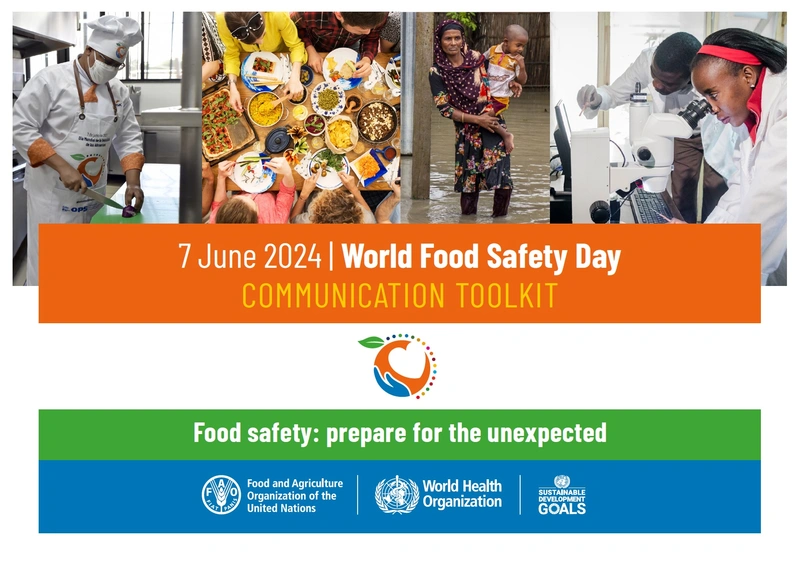
    This toolkit was developed by FAO and WHO to present information about the sixth World Food Safety Day, and to share ideas on how to take part in the celebrations on (or around) 7 June 2024.
    March 7, 2024
     World Food Safety Day 2023: Growing a greater awareness of food standards

    World Food Safety Day 2023: Growing a greater awareness of food standards

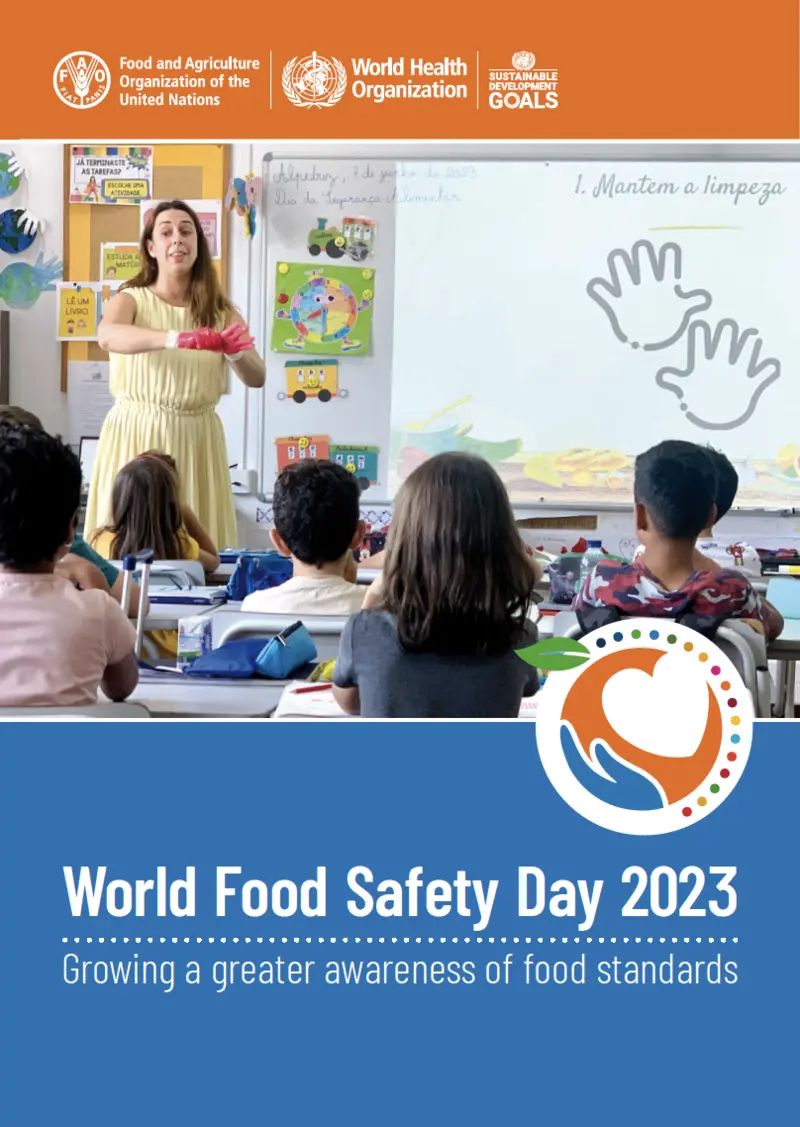
    In 2023, over 500 events were organized in at least 139 countries on the occasion of World Food Safety Day. Many of those were technical conferences and discussions organized by governments, the private sector and students to discuss how standards help to keep food safe. There were also walks, runs, gymnastics and dance, as well as songs, poster competitions, art exhibitions and lots more. Given t
    March 6, 2024
    Whole genome sequencing as a tool to strengthen foodborne disease surveillance and response

    Whole genome sequencing as a tool to strengthen foodborne disease surveillance and response

    Whole genome sequencing (WGS) is a laboratory technique that has the potential to change how we detect and monitor microbial hazards in the food chain, as well as how we assess, investigate and manage food safety risks. It is anticipated that this technology will help reduce the burden of foodborne diseases, given its advantages over previous low-resolution typing and detection methods.The purpose
    November 8, 2023
    Microbiological risk assessment: guidance for food

    Microbiological risk assessment: guidance for food

    Microbiological Risk Assessment Guidance for Food (MRA 36) provides a structured framework for assessing the risk of microbiological hazards in food.It updates three previous FAO and WHO guidance documents (MRA 3, MRA 7, and MRA 17) and brings them into a single volume, providing an overall umbrella for microbiological risk assessment. In doing so it captures the growth and experience in this fiel
    September 21, 2023
    Nine things to know about food safety aspects of cell-based food

    Nine things to know about food safety aspects of cell-based food

    The Food and Agriculture Organization of the United Nations (FAO) and the World Health Organization (WHO) launched the publication “Food safety aspects of cell-based food”. A factsheet was prepared for food safety competent authorities to grasp the contents of the publication. This document summarizes in nine points the main messages of the publication and includes some of the next steps that comp
    August 7, 2023
    Food safety is everyone's business in aquaculture

    Food safety is everyone's business in aquaculture

    This short document outlines the importance of food safety, the benefits and how food safety can be improved in aquaculture. It is part of a set of leaflets produced by FAO and WHO to promote food safety, in particular around World Food Safety Day.Other available languages العربية 中文 Русский Français Español
    May 29, 2023
    Food safety is everyone’s business in the primary production of milk

    Food safety is everyone’s business in the primary production of milk

    This short document outlines the importance of food safety, the benefits and how food safety can be improved in the primary production of milk. It is part of a set of leaflets produced by FAO and WHO to promote food safety, in particular around World Food Safety Day.Other available languages العربية 中文 Русский Français Español
    May 29, 2023